A Day Inside Qualcomm’s 6G Vision
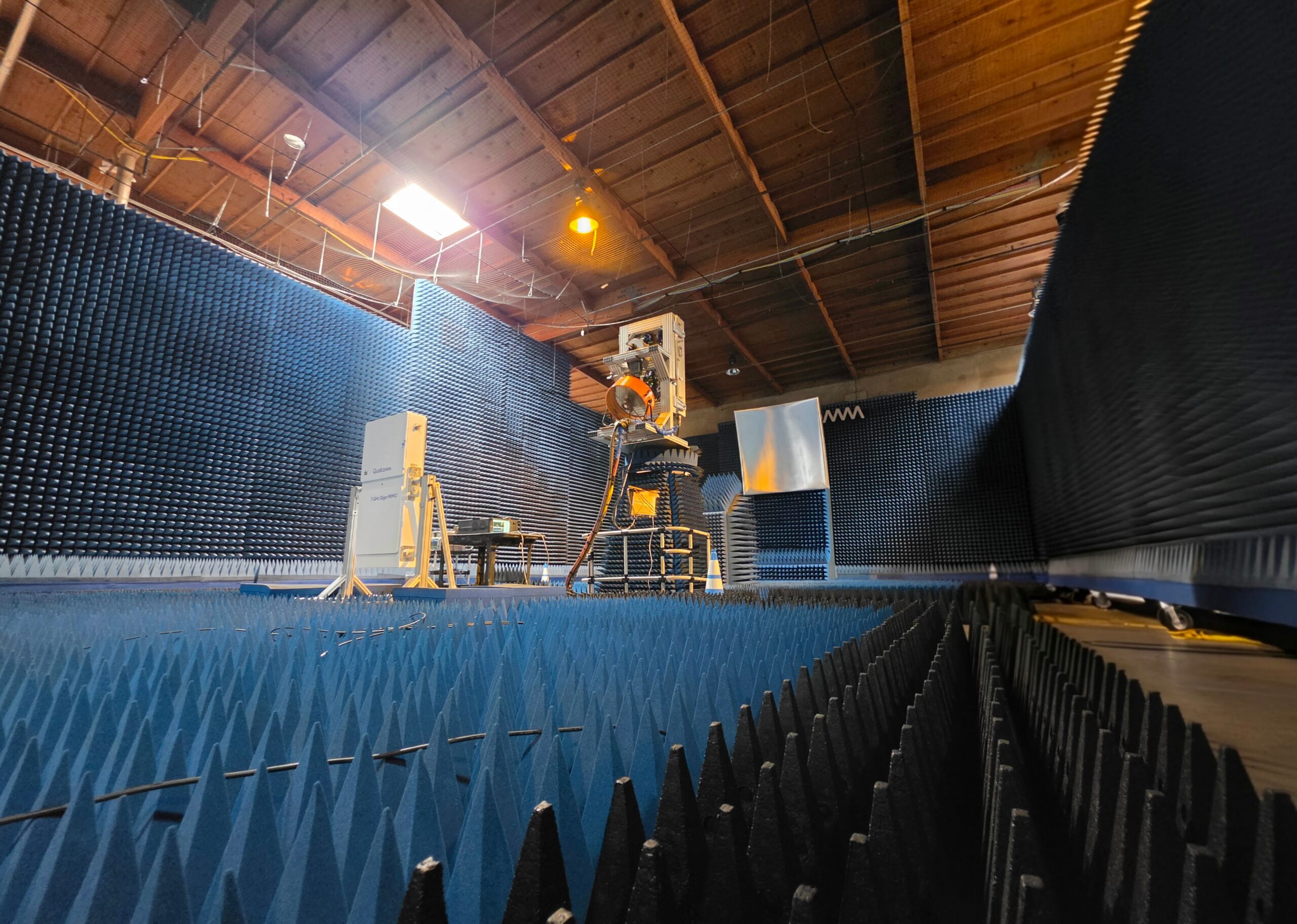
On August 26, a group of analysts and media spent the day at Qualcomm’s San Diego campus for its 6G Leadership Day: keynotes, technical sessions, live demonstrations, and enough material to keep us thinking well after the event ended. Qualcomm hosted our attendance at the event. No additional compensation was received.
We went in skeptical. 6G is still early enough that almost any discussion can turn into a collection of promises about a network that won’t be commercial for years. We expected plenty of that. What we found instead was a surprisingly pragmatic message: don’t redesign the parts of cellular that already work unless there is a measurable reason to do it. That doesn’t mean every part of Qualcomm’s 6G vision is convincing yet. Some of the projected traffic demand looks aggressive, and nobody has answered what may be the most important commercial question around Giga-MIMO: what will all of this radio hardware cost? But after seeing the prototypes, measurements, and direction of the standards work, we came away taking the engineering much more seriously than we did going in.
6G Isn’t Starting Over
Every wireless generation needs a reason to exist. 4G brought true mobile broadband. 5G added much more spectrum, massive MIMO, lower latency, and a network architecture capable of supporting a much wider range of services. So what exactly is 6G supposed to do? Qualcomm’s answer isn’t simply “go faster.” The company sees future networks supporting a much broader mix of AI-native devices, wearables, robots, vehicles, industrial systems, and distributed computing. That means the network has to become better at deciding where data should go, how quickly it needs to get there, and which device or compute resource should handle it.
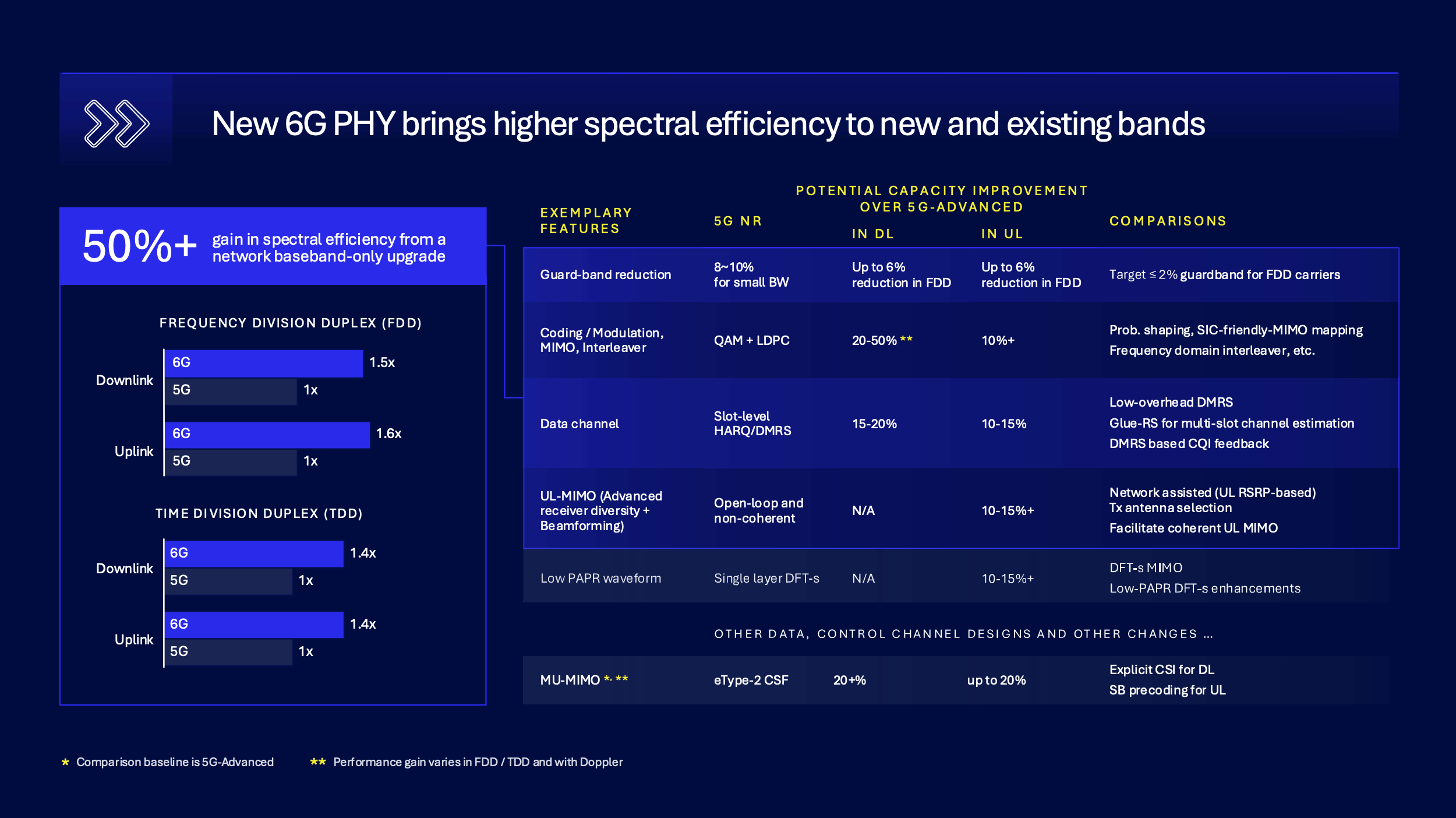
Interestingly, the radio itself isn’t being reinvented from scratch. Much of the foundational 5G physical layer is carrying forward. Qualcomm’s standards material shows continued use of familiar OFDM waveforms, NR-derived frame structures, and LDPC and Polar coding. The guiding principle is to change those foundations only where measurable improvements can be demonstrated. That sounds less exciting than inventing an entirely new air interface. It may also be much smarter. The industry already spent years making 5G’s radio architecture work across networks and devices around the world. Keeping the pieces that already work frees engineers to spend more time on the areas where 6G could actually move the needle: better uplink performance, wider channels, improved spectral efficiency, denser antenna arrays, sensing, smarter protocols, and cooperation between devices.
The Bigger Change May Be the Uplink
Cellular networks were built around a simple assumption: people download much more than they upload. Phones consume video, websites, music, and apps, while the downlink does most of the heavy lifting. AI could change that balance. Qualcomm showed several examples, including AI assistants, smart glasses that continuously share what the user sees, interactive AR, and 3D communication. A “see what I see” example assumed roughly 50 GB of monthly traffic, with about 90% of it traveling up to the network. Whether people actually use future AI glasses that aggressively remains an open question. The direction, however, makes sense.
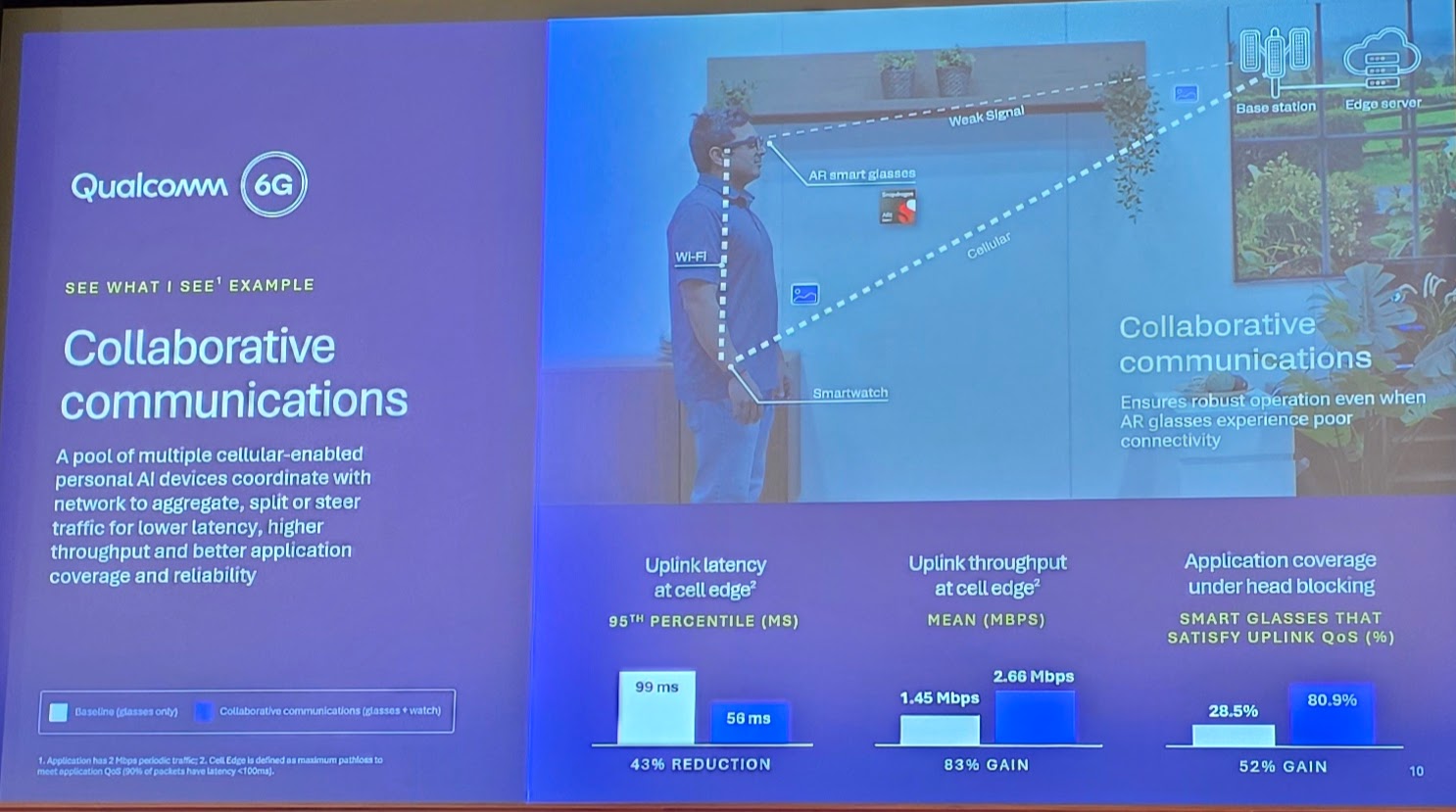
If devices are continuously sharing video, audio, sensor data, or context with an AI model, uplink performance becomes much more important than it is for today’s smartphone. One of Qualcomm’s best demonstrations showed how multiple personal devices could work together to solve that problem. Smart glasses have an obvious RF weakness: your head is directly next to the antenna. Depending on how you’re positioned relative to the cell site, your head can significantly attenuate the signal. Qualcomm demonstrated a system in which another wearable could provide an additional path to the network. The result was a 43% reduction in 95th-percentile uplink latency at the cell edge, an 83% increase in mean uplink throughput, and a jump from 28.5% to 80.9% in the percentage of sessions meeting the application’s uplink target under head-blocking conditions. That’s a much more interesting 6G story than another theoretical peak-speed record. Instead of forcing one tiny device to solve every RF problem by itself, the network can treat devices around you as a coordinated system with additional RF path diversity.
The Network Can Get Smarter, Too
Qualcomm also demonstrated what it calls context-aware communications. Today, network parameters are generally configured around defined operating conditions and standardized behavior. Qualcomm’s 6G concept gives the device more freedom to adapt those parameters within limits set by the network. Think of it as controlled flexibility rather than replacing the cellular protocol with AI. A device could recognize that a cloud-gaming session needs very low latency, that an AI video upload has suddenly become time-sensitive, or that a simple video scene doesn’t need as much bandwidth as a complex one. The baseband processor could then adjust protocol parameters within network-approved boundaries. In one video demonstration, Qualcomm reported roughly 33% lower bandwidth consumption with less than a 2% change in its perceptual video-quality score. Another cloud-gaming demo showed fewer latency spikes under bursty interference by dynamically adapting radio protocol parameters. That is probably a better way to think about AI-native 6G: not AI magically replacing the network, but a network that is better at adapting to what the user is actually trying to do.
Giga-MIMO Is the Technology to Watch
The most consequential piece of engineering we saw was Giga-MIMO. The problem it tries to solve is simple: operators need more spectrum, and one of the most promising places to find it is higher in frequency, particularly in the upper-mid-band range around 6 to 8 GHz. There, channels as wide as 400 MHz could become possible — roughly four times what is common in many current mid-band 5G deployments. The problem is physics. Higher frequencies generally suffer greater path loss and worse building penetration. If each cell covers less area, operators need more cell sites, and cell sites are expensive. Giga-MIMO tries to compensate by packing far more antenna elements into roughly the same physical space.
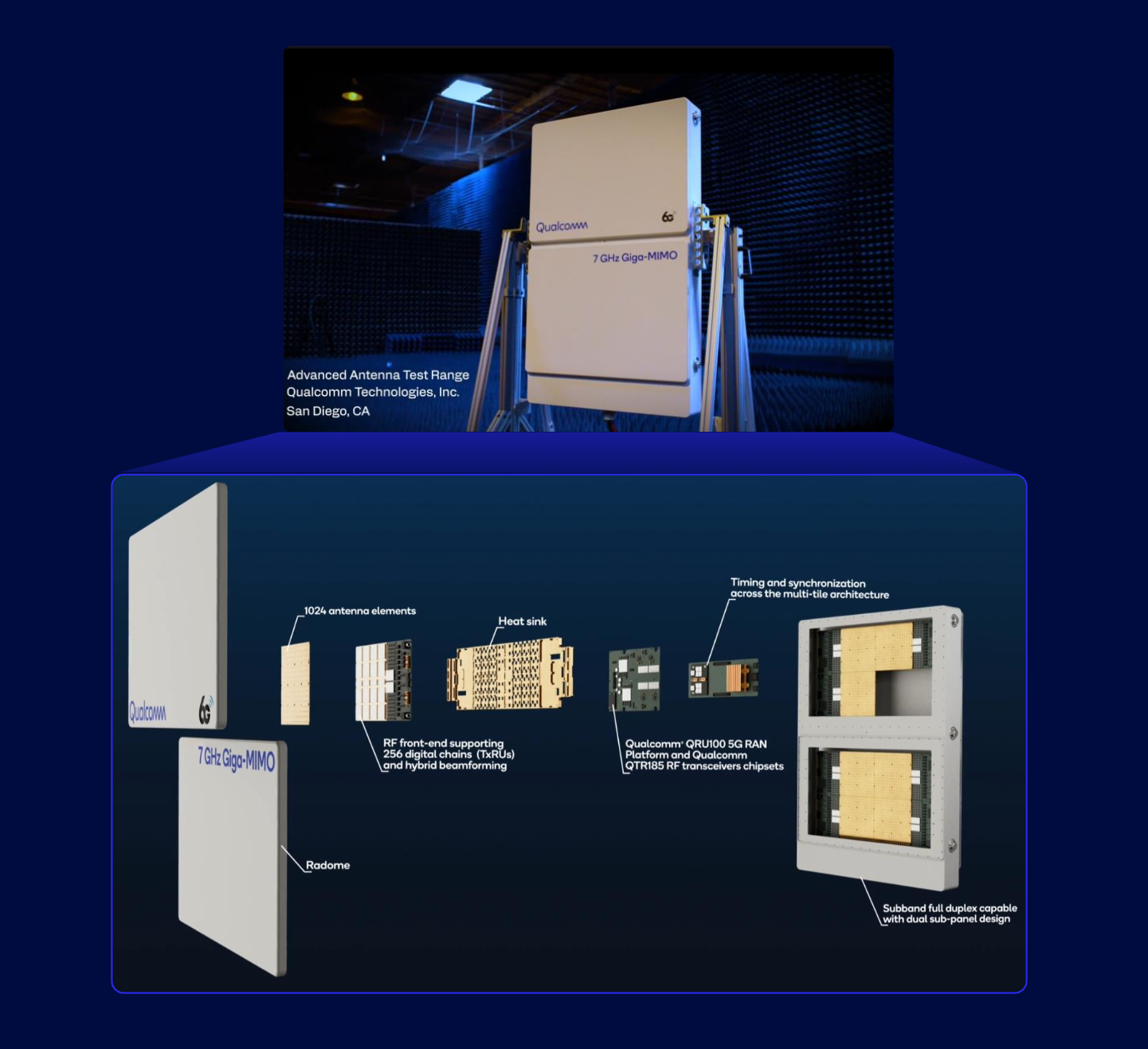
Qualcomm showed both 7 GHz and 13 GHz prototypes. The 7 GHz design uses 512 dual-polarized antenna locations, equivalent to 1,024 polarization-specific radiating elements. The 13 GHz version scales that to 2,048 dual-polarized locations, or 4,096 polarization-specific elements. Both can support up to 256 digital transmit and receive chains. Why can Qualcomm fit so many more antennas at 13 GHz? Because wavelength gets shorter as frequency increases. A shorter wavelength allows smaller antenna elements, so more of them can fit into the same physical space. The larger array can then produce greater directional antenna gain. The numbers from the prototypes make the point unusually clear. Both radios list the same +43 dBm total radiated power (TRP). The 7 GHz design has at least 29 dBi of peak TDD antenna gain, resulting in 72 dBm effective isotropic radiated power (EIRP). The 13 GHz design reaches at least 35 dBi and 78 dBm EIRP. That’s roughly 6 dB higher peak EIRP without increasing the radio’s stated transmit TRP. For comparison, the free-space path-loss difference between 7 and 13 GHz at the same distance is about 5.4 dB. So on paper, the additional antenna gain is enough to roughly compensate for the additional free-space loss. In simple terms, Giga-MIMO uses the shorter wavelength at higher frequencies to fit more antenna elements into the same space, creating additional antenna gain that helps offset much of the added path loss.
There are important caveats. This does not make 13 GHz propagate like 7 GHz. Building penetration, non-line-of-sight performance, foliage, diffraction, device antennas, and other real-world effects still matter. Qualcomm’s own major deployment claim—that 7 GHz Giga-MIMO can approach 3.5 GHz coverage without additional cell densification—is still a vendor claim, not something proven across commercial networks. But if that general idea survives real-world deployment, it could be enormously important. The difference between adding new radios to existing sites and having to build thousands of additional sites can determine whether a new spectrum band makes economic sense at all. That’s why Giga-MIMO matters more than the headline speed numbers.
The Hardware Is Already Real
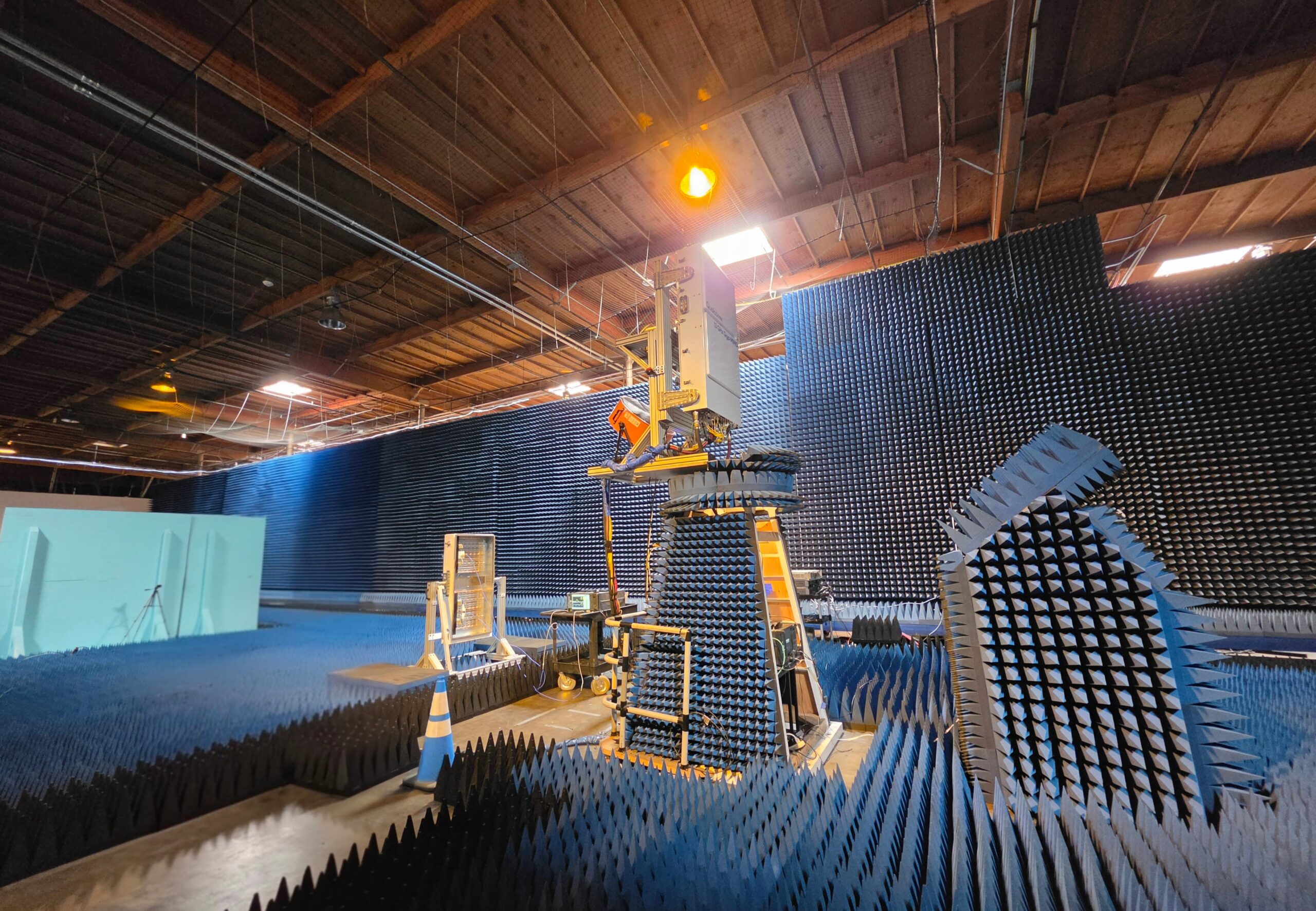
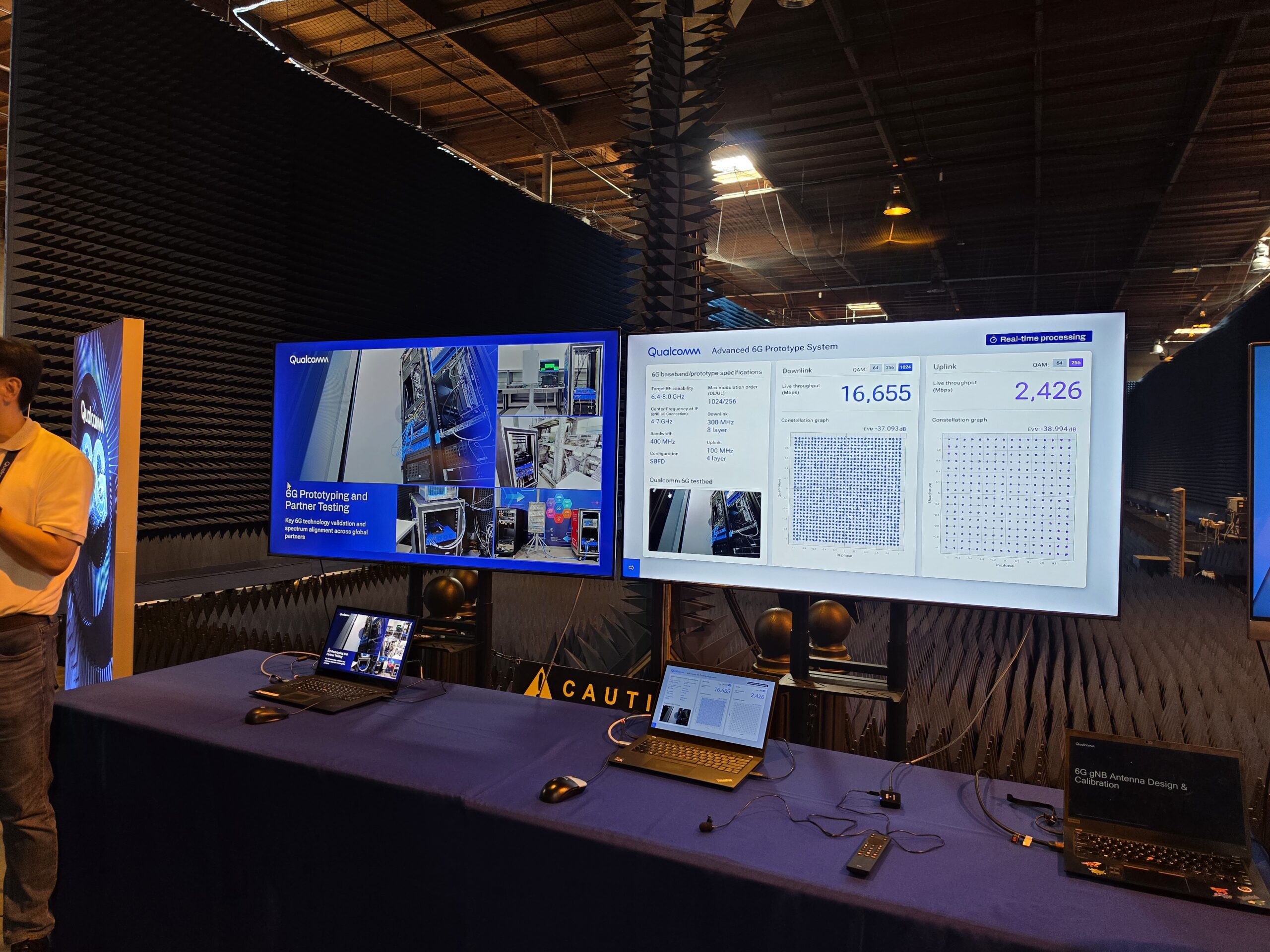
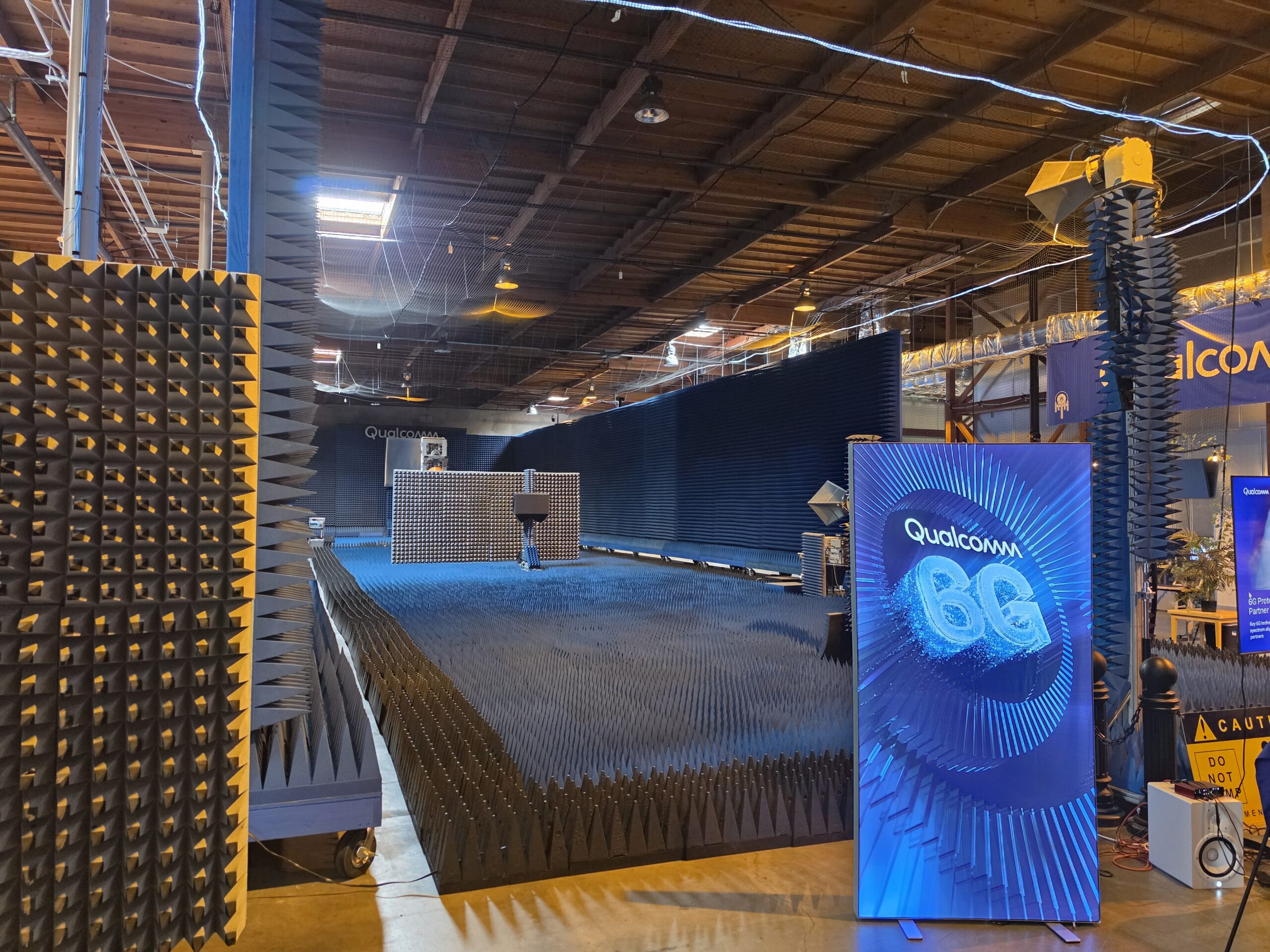
These weren’t just diagrams. Qualcomm had working antenna hardware and a dedicated compact antenna test range to support its claims with real measurements rather than simulations alone. The test facility uses a 2.2-meter reflector to create an effective plane wave across the antenna under test, allowing large arrays to be evaluated indoors in a controlled environment. That still doesn’t tell us how Giga-MIMO performs around a concrete building in a real city. Only field testing can do that. But it does show that these arrays are being built, tested, and characterized as real radio systems—not just concepts on paper. The same was true of Qualcomm’s 6G baseband testbed. A live system was running a 400 MHz channel using subband full duplex, with 300 MHz assigned to downlink and 100 MHz to uplink. With eight downlink spatial layers using 1024-QAM and four uplink layers using 256-QAM, the system showed about 16.7 Gbps down and 2.4 Gbps up in real time. Another demonstration showed probabilistic constellation shaping producing a 1.6 dB SNR improvement at a 10% target block-error rate. None of those techniques individually defines 6G. The real story is how these pieces come together. More spectrum, more antenna gain, more spatial layers, stronger uplink, smarter duplexing, more efficient modulation and coding. Rather than looking for one miraculous breakthrough, 6G is stacking a lot of smaller ones.
Sensing Becomes Part of the Network
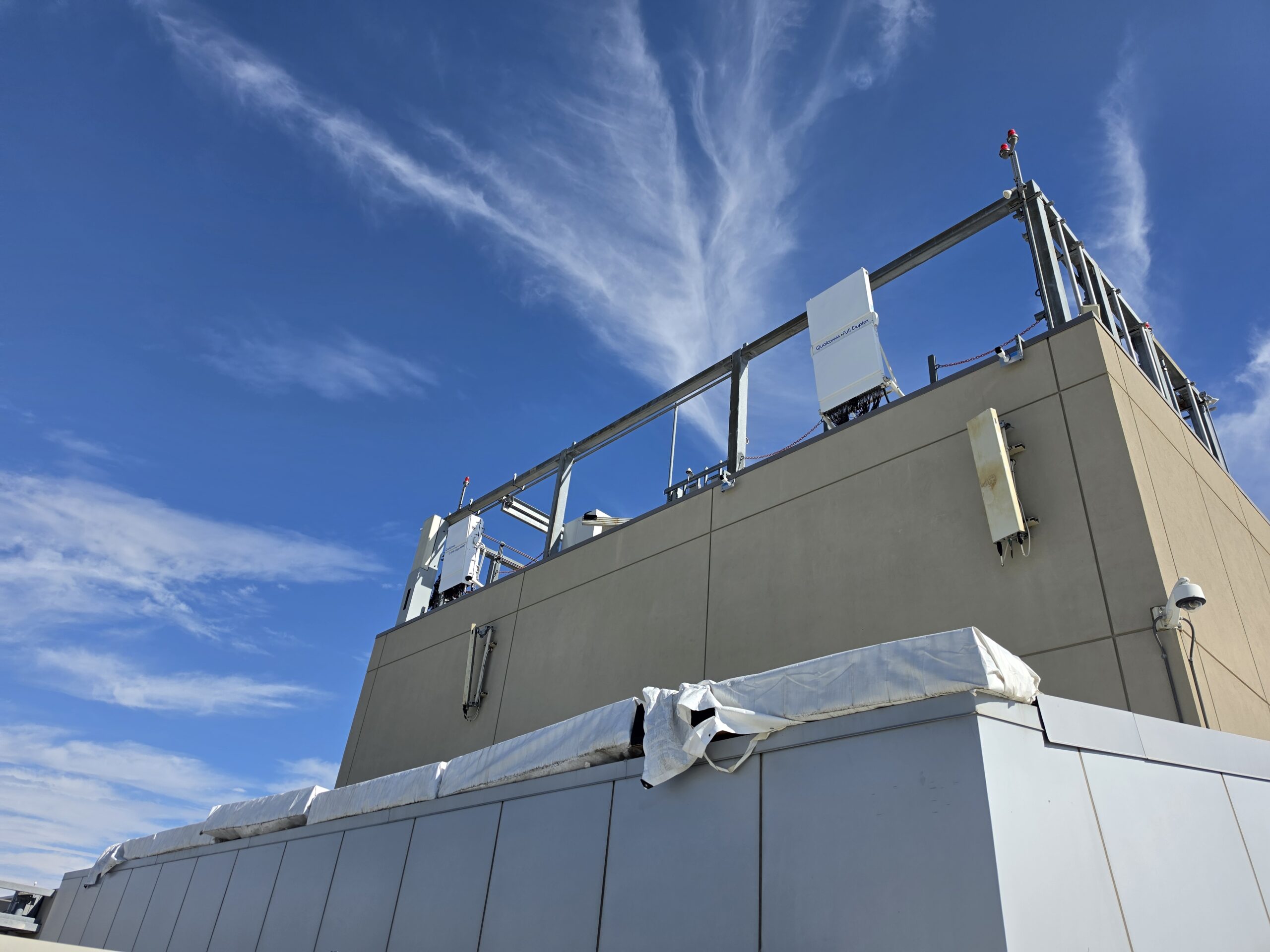
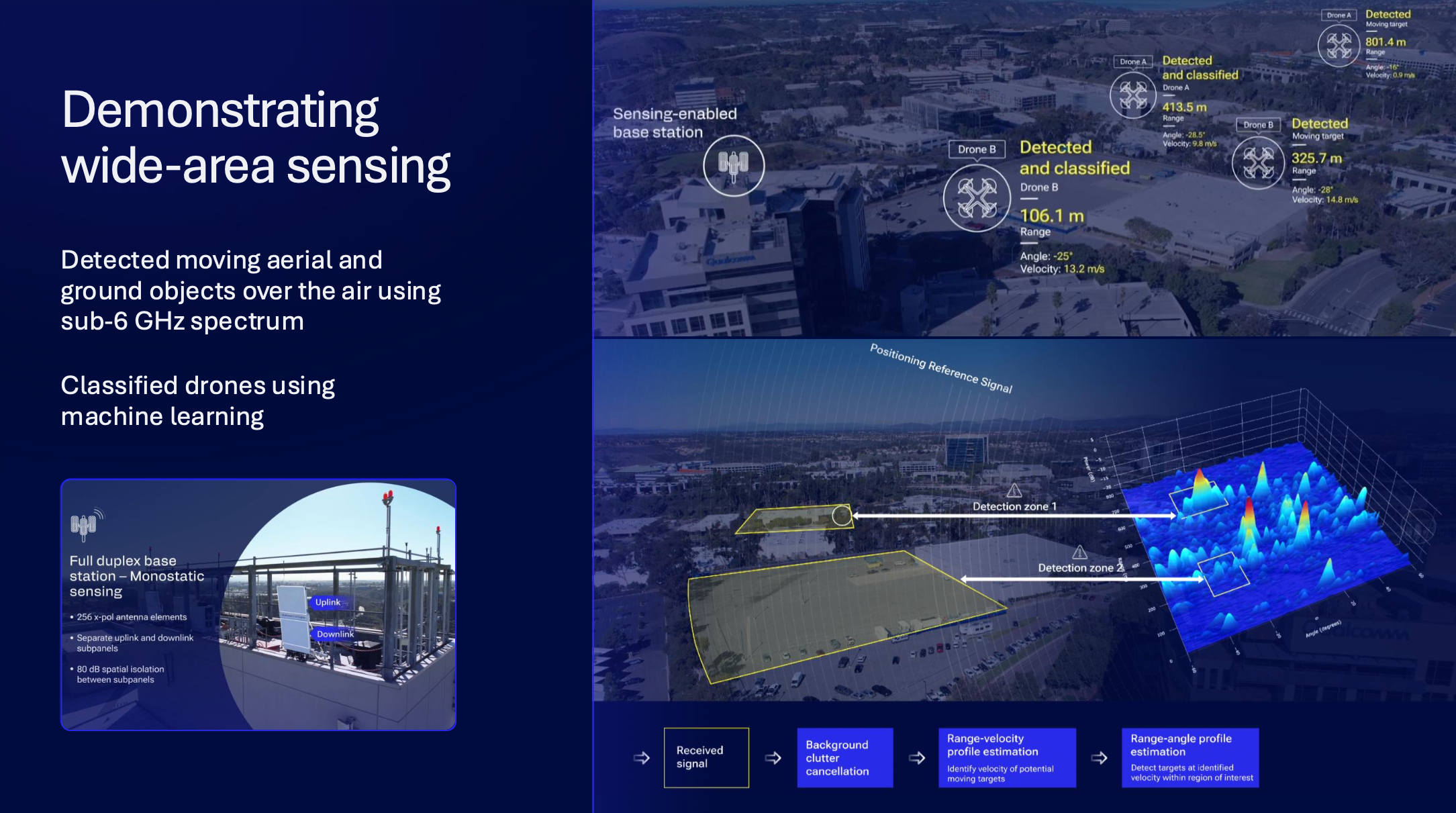
Another area becoming more tangible is Integrated Sensing and Communication (ISAC). The idea is to let cellular infrastructure do more than communicate with devices. By analyzing reflected radio signals—including Doppler shifts from moving objects—the network could detect, locate, and track objects. Qualcomm demonstrated a base station detecting moving aerial and ground targets and classifying drones using machine learning in real time. The 3GPP roadmap is moving in the same direction. Release 19 established sensing channel models. Release 20 studies base-station sensing of drones using existing NR-derived signals, while future 6G work is expected to expand the number of sensing modes, supported objects, and available bandwidth. This doesn’t mean cellular has invented radar. It means radar-like sensing could eventually become a standardized capability of infrastructure that is already deployed for communications. Potential applications range from drone tracking to road monitoring, robotics, security, and digital twins. Whether operators can turn that into a business is another question.
The Smartphone OEMs Have to Keep Up
Qualcomm’s target for high-performance 6G mobile devices is also aggressive: 4 transmit antennas and 8 receive antennas, targeting up to four simultaneous uplink spatial layers and eight downlink layers. That matters because today’s cellular systems are much more advanced on the downlink than the uplink. 6G is clearly trying to narrow that gap. Qualcomm is also looking at smarter transmit-antenna selection, uplink waveforms with a lower peak-to-average power ratio, longer uplink transmissions, coordinated power management, and combinations of lower-frequency FDD spectrum with higher-frequency TDD spectrum. Again, there isn’t one feature doing all the work. The uplink is being improved from several directions at once.
6G also has a much clearer standards schedule now. Qualcomm’s timeline puts the Release 21 6G Radio work item in March 2027, the physical-layer freeze in September 2028, the protocol-design freeze in December 2028, and the final ASN.1 freeze in March 2029. Qualcomm is targeting a commercial 6G modem-RF launch in the second half of 2029. That doesn’t mean everyone gets 6G in 2029, but the industry is no longer talking about 6G on an undefined horizon. There is a real engineering schedule.
So What Is the Killer App?
Nobody knows. And that may be the wrong question this early. 5G is a useful reminder. Some of the applications discussed most aggressively in the early 5G years developed more slowly than expected. Meanwhile, fixed wireless access became one of the clearest commercial successes. 6G may follow the same pattern. AI glasses could become a major product category. Robotics could become a significant source of wireless demand. Network sensing could open completely new services. Or the biggest application may be something nobody at Qualcomm’s event talked about. The network doesn’t need to predict the winner perfectly. It needs to provide broadly useful capabilities that give new applications room to emerge: better uplink, more spectrum, improved spectral efficiency, smarter devices, more adaptable protocols, and integrated sensing. Those capabilities have value even if today’s favorite 6G application never becomes the killer app.
Where We Landed
We went into Qualcomm’s 6G Leadership Day expecting more marketing than engineering. We left with a different view. Giga-MIMO is the most consequential idea we saw. If very large upper-mid-band arrays can provide useful macro coverage without requiring major site densification, they could make hundreds of megahertz of new spectrum economically practical. That remains a big if.
Real-world propagation, building penetration, handset performance, radio cost, power consumption, thermal behavior, and deployment economics still need much more validation. But the engineering direction is credible. Collaborative communications improved uplink latency, throughput, and reliability by letting nearby wearable devices work together when one had a weak connection. Dynamic QoS and adaptive protocols were demonstrated live. Integrated sensing is moving into standards work. The device roadmap puts greater emphasis on the uplink, while 3GPP appears willing to reuse the parts of 5G that already work rather than reinvent them simply because the generation number changed.
We still have questions, but they are different questions from the ones we had going in. The question is no longer whether there is meaningful engineering underneath the 6G marketing. There is.
The harder question is whether that engineering can make the jump from a laboratory in San Diego to millions of devices and thousands of commercial cell sites.
For the first time, we can see a plausible path.
